
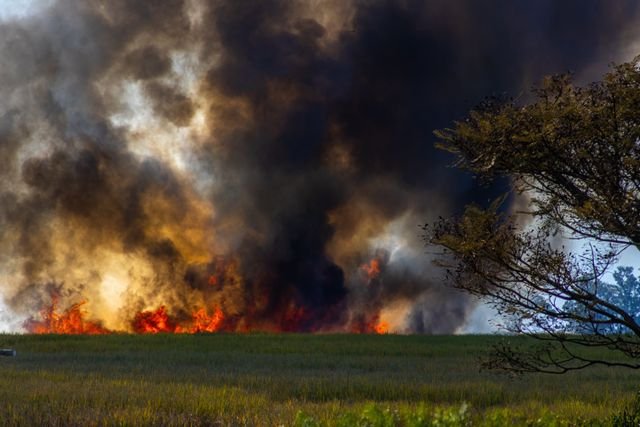
Summer 2026 delivered record heat, wildfires, drought and severe pressure on health services, water supplies and infrastructure. Yet much of the media still treated these events primarily as weather stories. The best coverage explained the climate connection; too much of it stopped short of interrogating the governments and fossil fuel companies whose decisions made the impacts more likely, more damaging and more expensive.
A summer that made the science unavoidable
The evidence linking this summer’s extremes to human-caused climate change was unusually strong. The BBC reported the Met Office’s provisional finding that summer 2026 was the UK’s hottest on record, with an average mean temperature of 16.5C, five widespread heatwaves and 40 days above 30C. It also reported the Met Office’s attribution finding that human-induced climate change made the season’s average temperature around 130 times more likely.
The BBC’s earlier reporting was similarly clear on causation. In June, it explained that human-induced climate change had made warm spells significantly hotter than comparable weather systems in the past, while its August satellite-imagery article stated plainly that climate change, mainly caused by burning fossil fuels, had raised average temperatures and made hot spells more likely and intense.
The human cost was also quantified. The BBC reported research from the London School of Hygiene & Tropical Medicine, Imperial College London and the Met Office finding that climate change was responsible for around 42% of heat-related deaths in England and Wales during the summer.
Where the media got it right
Some outlets did connect extreme weather to emissions and policy failure. The New York Times editorial board went further than most, arguing that the summer’s heat and humidity were “the result” of continued fossil fuel burning and criticising political leaders for talking about climate less even as impacts intensified. It specifically criticised the Trump administration for supporting the cancellation of clean-energy projects and keeping ageing coal plants open.
The New York Times also examined accountability through the courts. Its reporting on Roger Worthington and Multnomah County’s $50 billion lawsuit described an attempt to hold oil producers responsible for a specific deadly heatwave, arguing that the companies had downplayed the risks of global warming. A later opinion piece discussed the broader legal stakes, noting more than 20 civil lawsuits brought by municipalities seeking to hold fossil fuel companies responsible for climate damages.
The Guardian was also among the more consistent UK outlets. An Energy and Climate Intelligence Unit analysis found that The Guardian mentioned climate change in 63.7% of its wildfire articles between 22 May and 31 July, one of only two UK national newspapers to do so in a majority of relevant articles. In its heatwave coverage, it referred to the climate crisis in roughly half of its 131 heat-related articles.
Reuters provided useful reporting on the systemic consequences of extreme heat, including the UN climate chief’s warning that Europe’s summer heatwaves had added inflationary pressure and could contribute to a winter fuel crisis. Le Monde went further into governance failures, reporting that German states and municipalities carry responsibility for adaptation while the federal government can intervene mainly after a crisis, leaving Germany without a nationwide heat action plan.
The missing question: who is responsible?
Even strong attribution reporting often leaves responsibility vague. The BBC, for example, correctly reported that fossil fuel burning is the main driver of warming and that climate change made 2026’s UK summer around 130 times more likely. But its coverage largely presented this as a scientific and meteorological fact rather than as the outcome of specific corporate strategies, regulatory choices and political delays.
That distinction matters. Saying that “climate change” made a heatwave more likely is accurate, but incomplete. A fuller account would identify the fossil fuel producers whose products generated the emissions, the governments that licensed and subsidised extraction, the companies that delayed transition plans, and the policymakers who failed to invest in heat resilience.
The strongest examples of this more accountable journalism came from opinion and investigative coverage rather than routine breaking-news reporting. The New York Times explicitly connected extreme heat to fossil fuel combustion and to government decisions that prolonged coal generation. Its reporting on climate litigation also made corporate accountability a central part of the story.
By contrast, much routine coverage remained at the level of impacts and warnings. BBC Newsround, for instance, told younger audiences that summers were expected to become hotter as carbon emissions continued to heat the planet, but did not examine which companies or governments were responsible for those emissions or what policy changes should follow.
UK newspapers often omitted the cause
The gap was especially visible in UK national newspapers. The ECIU analysed 2,806 articles about wildfires published by nine national titles between 22 May and 31 July. It found that 65.4% did not mention climate change at all. Only the Financial Times and The Guardian mentioned climate change in a majority of their wildfire coverage.
The analysis covered the Daily Telegraph, The Times, the Financial Times, The Independent, The Guardian, the Daily Mail, the Daily Express, The Sun and the Daily Mirror. That means much of the UK’s most widely read press reported fires, evacuations and drought without explaining the conditions that made them more severe.
Heatwave reporting was similarly weak. A separate ECIU analysis of nearly 2,500 articles published during the record-breaking June heatwave found that about 72% made no reference to climate change or global heating. Fewer than one in 20 reports mentioned net zero or government climate policy.
This is not simply an omission of scientific context. It is an omission of democratic context. If readers are told to drink water and avoid travel, but not told that emissions from fossil fuels made the heat more dangerous—or that policy choices determine how quickly emissions fall—then the public is left with individual coping strategies rather than political leverage.
Fox News and the politics of omission
In the United States, the omission was more overt. Fox News reported on the record-breaking heatwave and its impacts, including suspected heat-related deaths in New Jersey, but was criticised for not mentioning climate change as an underlying cause. A Fox News segment also framed debate around whether European claims about air conditioning and emissions were credible, rather than examining the established link between fossil fuel emissions and intensifying heat extremes.
This illustrates a wider problem: when climate change is treated as a partisan argument rather than a physical risk, coverage can become a contest over whether to mention the cause at all. The consequence is not neutrality. It is a distorted public debate in which the impacts are visible but the responsibilities are obscured.
Governments need harder questions
Business accountability matters, but governments cannot be allowed to hide behind corporate responsibility. Governments approve fossil fuel projects, set tax and subsidy regimes, regulate corporate disclosure, decide planning rules, fund adaptation and determine how quickly the energy system changes.
Summer 2026 should have prompted questions such as:
- Why are new fossil fuel infrastructure approvals still compatible with national climate targets?
- Which ministers approved projects or policies that increase emissions?
- Why are heat-health plans, building standards and grid resilience still inadequate after repeated warnings?
- What enforceable dates, budgets and legal mechanisms will ensure emissions fall rather than merely being reported?
- Who will pay for adaptation and loss: taxpayers, insurers, households or the companies most responsible for cumulative emissions?
Le Monde’s reporting on Germany’s fragmented adaptation responsibilities showed the value of this kind of scrutiny. The New York Times similarly showed how editorial coverage can name the political decisions that keep fossil fuels in the system. These are the models that mainstream reporting should follow more consistently.

From weather reporting to accountability reporting
The media does not need to abandon clear, accessible reporting on temperatures, wildfires and emergency responses. It needs to add the questions that turn a weather event into a public-interest story.
A stronger report would say not only: “Climate change made this heatwave more likely.” It would say: “Fossil fuel emissions made this heatwave more likely; these companies produce and profit from those fuels; these governments approved, subsidised or failed to regulate them; and these decisions left hospitals, homes and workers exposed.”
Summer 2026 provided the evidence, the casualties and the policy failures. What remains missing from too much coverage is the willingness to name the responsible parties and hold them to account.
Sources
- BBC News, Summer 2026 was UK’s hottest on record, Met Office says: https://www.bbc.co.uk/weather/articles/c99dypl3jgmobbc.co
- BBC News, Europe’s new climate in seven charts: https://www.bbc.com/news/articles/c8e2j0j87reobbc
- BBC News, What will you tell your grandchildren about the summer of ’26?: https://www.bbc.com/news/articles/cq5x2yn89e2obbc
- BBC News, Europe’s scorched landscapes seen from space: https://www.bbc.com/news/articles/c4gxy0wqqd9obbc
- BBC News, Just how hot and dry was your summer?: https://www.bbc.co.uk/news/articles/cy9zvw47v90onationalheraldindia
- BBC Newsround, Summer 2026 could be the UK’s hottest ever: https://www.bbc.co.uk/newsround/articles/c80n9ljnxy4obbc
- The New York Times, editorial, Extreme Heat Is Here to Stay: https://www.nytimes.com/interactive/2026/09/05/opinion/editorials/extreme-heat-summer.htmlnytimes
- The New York Times, Roger Worthington Is Suing Over a Heat Wave: https://www.nytimes.com/2026/07/14/climate/roger-worthington-portland-oil-industry-lawyer.htmlnytimes
- The New York Times, The Science That Has Oil Companies Running Scared: https://www.nytimes.com/2026/10/06/opinion/oil-companies-supreme-court.htmlnytimes
- Energy and Climate Intelligence Unit, via The Media Leader, Two-thirds of UK news articles about wildfires this summer haven’t mentioned climate change: https://uk.themedialeader.com/two-thirds-of-uk-news-articles-about-wildfires-this-summer-havent-mentioned-climate-change/themedialeader
- National Herald, reporting ECIU analysis of UK heatwave coverage: https://www.nationalheraldindia.com/environment/nearly-three-fourths-of-uk-heatwave-news-reports-failed-to-mention-climate-crisis-analysislemonde
- Reuters, EU’s summer of “hellish heat” adding to inflation pressures: https://www.reuters.com/sustainability/cop/eus-summer-hellish-heat-adding-inflation-pressures-says-un-climate-chief-2026-09-10/
- Le Monde, Heatwaves coverage: https://www.lemonde.fr/en/heatwaves/
- Twitchy, reporting criticism of Fox News heat coverage: https://twitchy.com/warren-squire/2026/07/06/bernie-sanders-heat-story-climate-change-he-flies-private-jets-n2429936bbc.co
- Fox News, French politician blames global heat wave on US air conditioning: https://www.foxnews.com/video/6399843792112