

Double materiality should do more than satisfy CSRD requirements: it should help leaders decide where to focus time, capital and management attention. A strong assessment is therefore one that is both defensible to auditors and genuinely useful for strategy.
Why robustness matters in double materiality
A double materiality assessment is only credible if it can explain not just what was judged material, but why. That means clear criteria, consistent scoring, documented assumptions and a traceable link between sustainability topics and business reality.
It also needs to survive scrutiny from more than one angle: assurance providers, senior management, investors and internal risk teams will each test it differently. If the process is opaque, too broad or detached from the business model, it quickly becomes a compliance exercise rather than a management tool.
Example: heat stress in a manufacturing group
Consider a global manufacturer with plants in southern Europe and Southeast Asia. Local communities raise concerns about worker health during summer heatwaves, while operations teams report more frequent production interruptions as temperature thresholds are exceeded.
In a robust double materiality assessment, “climate change adaptation and worker health” might be scored as high impact materiality due to the severity and scope of potential harm, and high financial materiality because of disruption to output, overtime costs and capex for cooling investments. This topic then becomes a clear input to site investment decisions, climate resilience planning and HR policies, not just a disclosure line.
Build the right scope
Start with the business model, value chain and strategic context, then identify the stakeholders and sustainability matters most likely to matter for this specific organisation. Best practice is to combine top‑down strategic analysis with bottom‑up input from affected stakeholders, rather than relying on a generic sector list.
A robust longlist usually draws on ESRS topical standards, regulatory scanning, peer benchmarking and stakeholder engagement. That mix reduces blind spots and helps avoid “everything is material” outcomes, while still keeping the assessment relevant to the company’s actual footprint and risks.

Example: downstream impacts in a consumer brand
A consumer goods company might discover through stakeholder interviews that the biggest perceived impacts are not in its factories but in product use and end‑of‑life – for instance, plastic packaging leakage and the health impacts of high‑sugar products.
A well‑designed scope therefore includes downstream value chain stages and consumer groups as stakeholders, rather than focusing solely on internal operations. That, in turn, changes which topics come out as material and where mitigation efforts are targeted (for example, reformulation, packaging redesign and take‑back schemes).
Make the scoring defensible
The heart of the exercise is the scoring logic. For impact materiality, companies should translate the ESRS concepts of scale, scope, irremediability and likelihood into tailored guidance that different assessors can apply consistently; for financial materiality, they should assess magnitude, likelihood, time horizon and connection to strategy.
The key is to make judgement explicit. If a topic is scored high because the impact is severe but uncertain, or because a financial effect is smaller today but likely to grow, that reasoning should be written down in plain language.
Example: biodiversity versus short‑term margin
A food retailer operating in areas of high biodiversity risk might rate nature loss as having very high impact materiality due to land‑use change and supply‑chain impacts, even if the immediate financial effect appears moderate. Over time, though, the company recognises that biodiversity regulation and shifting consumer preferences could significantly affect sourcing costs and brand value, so it scores financial materiality as medium‑to‑high over a longer time horizon.
By documenting this explicitly – including the assumed time horizon and regulatory pathways – the company gives auditors and investors a clear narrative for why biodiversity has been prioritised alongside more “traditional” cost and margin topics.
Keep it decision‑useful
A good assessment should change decisions, not just disclosures. The output should feed into risk registers, strategic planning, capital allocation, target setting and disclosure scoping, so that material topics shape management action throughout the year.
One useful discipline is to ask of every material topic: “What decision will this inform?” If the answer is unclear, the assessment may be too abstract or too detailed to be useful. That question helps keep the process focused on the few issues that really matter.
Example: from materiality matrix to capex plan
An energy utility might identify “grid resilience and reliability under climate change” as highly material on both impact and financial dimensions. The assessment output is then used to prioritise grid reinforcement projects in flood‑ and fire‑prone areas, inform insurance strategy and shape scenario analysis for the board’s risk committee.
Because the same topic also drives ESRS E1‑related disclosures, there is a clear golden thread from the matrix to capital expenditure, risk reporting and sustainability statements. That is what decision‑useful double materiality looks like in practice.
Document for assurance
Assurance‑ready assessments are built, not patched together at the end. You need a full audit trail covering scope, stakeholder groups, data sources, thresholds, workshop notes, scoring rationale, escalation points and sign‑off decisions.
That documentation also improves internal learning. When the assessment is repeated annually, teams can compare changes in thresholds, stakeholder views and business context, instead of re‑running the exercise from scratch each year.
Example: an audit‑ready trail
For a bank running its second CSRD‑aligned double materiality assessment, the project team maintains a shared evidence log with links to climate risk models, portfolio heatmaps, human rights impact assessments, stakeholder interview summaries and management committee minutes.
When the assurance provider reviews the work, they can test specific scoring decisions (for example, why “access to finance for vulnerable groups” was upgraded from medium to high) against the underlying evidence and governance record, instead of having to rely on verbal explanations.
Common failure points
The most common weaknesses are predictable: vague criteria, poor stakeholder engagement, inconsistent scoring across topics, weak links to strategy and over‑reliance on one‑off workshops. These issues make the result harder to defend and less useful for decision‑making.
Another recurring problem is static thinking. Materiality changes when the business changes, regulation changes or the external environment shifts, so the assessment needs regular refreshes rather than being treated as a one‑time project.
A practical operating model
A strong operating model is usually cross‑functional. Sustainability, finance, risk, operations, procurement and legal should all contribute, with senior leadership reviewing the final outcome so it aligns with governance and risk appetite.
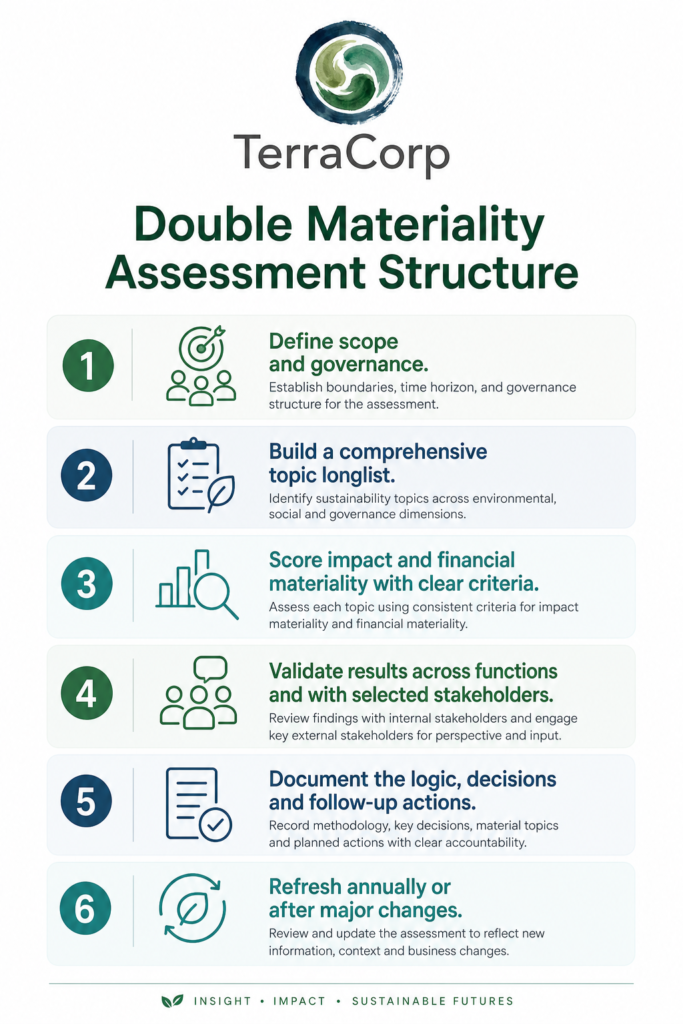
A simple structure is:
- Define scope and governance.
- Build a comprehensive topic longlist.
- Score impact and financial materiality with clear criteria.
- Validate results across functions and with selected stakeholders.
- Document the logic, decisions and follow‑up actions.
- Refresh annually or after major changes.
Closing thoughts
The best double materiality assessments are rigorous enough for assurance and practical enough to guide strategy. They are transparent, repeatable and clearly linked to business decisions, which is what makes them both credible and useful.
Sources
- Fiegenbaum Solutions – “Double materiality analysis: definition, process & best practice” (overview of steps, criteria and governance model). Available at: https://www.fiegenbaum.solutions/en/double-materiality-analysis-definition-process-best-practice
- PwC Malta – “Understanding the CSRD double materiality assessment process” (practical guidance on ESRS‑aligned assessments). Available at: https://www.pwc.com/mt/en/publications/sustainability/understanding-the-csrd-double-materiality-assessment-process.html
- Thomson Reuters – “How to conduct a double‑materiality assessment to comply with the CSRD” (compliance‑focused perspective and examples). Available at: https://www.thomsonreuters.com/en-us/posts/esg/csrd-double-materiality-assessment
- EY Ireland – “CSRD and double materiality: where to begin” (getting started, common pitfalls and operating model). Available at: https://www.ey.com/en_ie/insights/sustainability/csrd-how-to-manage-your-double-materiality-assessment
- PwC US – “What is double materiality under CSRD?” (context on CSRD, ESRS concepts and financial versus impact lenses). Available at: https://www.pwc.com/us/en/services/esg/library/csrd-double-materiality.html
- Nordic Sustainability – “ESRS Double Materiality Assessment: Step‑by‑step guide” (detailed, ESRS‑specific process and examples). Available at: https://nordicsustainability.com/insight/esrs-double-materiality-assessment-step-by-step-guide
- IntegrityNext – “Double Materiality Assessment – What it is & how to conduct one” (focus on supplier and value‑chain aspects). Available at: https://www.integritynext.com/double-materiality-assessment
- Sweep – “What is double materiality?” (short explainer with value‑creation emphasis). Available at: https://www.sweep.net/blog/what-is-double-materiality
- Ricardo – “Demystifying double materiality assessments” (sector examples and lessons learned). Available at: https://www.ricardo.com/en/news-and-insights/industry-insights/demystifying-double-materiality-assessments
- Deloitte – “Unpacking the Double Materiality Assessment Under the CSRD and ESRS” (assurance angle and governance considerations). Available at: https://dart.deloitte.com/USDART/home/publications/deloitte/heads-up/2024/csrd-esrs-double-materiality-assessment